
Genoa: The Italian City Most Americans Fly Right Past
Ask ten friends about their Italy trip and you’ll hear the same names. Rome. Florence. Venice. Maybe the Amalfi Coast if somebody splurged.
Genoa almost never makes the list. And honestly? That’s a little wild.
This is the city that gave us pesto, focaccia, and Christopher Columbus. It’s the capital of Liguria, home to roughly 560,000 people, and one of the busiest ports on the Mediterranean. It also has one of the largest medieval old towns in Europe, and you can wander it without bumping into a tour group every thirty seconds.
So why do people skip it? Mostly because Genoa doesn’t try very hard to impress you. It’s a working port. It’s a bit scruffy. There’s laundry hanging over the alleys and scooters squeezing past you. But there’s a catch: the scruffy part is the charm. Give it two days and it gets under your skin.
Here’s what I’d tell a friend who’s thinking about going.
So What’s the Deal With This Place?
A little history helps, so bear with me for a minute.
For centuries, Genoa was a maritime republic and a serious rival to Venice. Its merchants and bankers got rich, and they built palaces to prove it. The city’s old nickname is “La Superba,” which means “the Proud One.” Fair enough.
That money left a mark you can still see. The Strade Nuove and the Palazzi dei Rolli, a group of Renaissance and Baroque palaces, became a UNESCO World Heritage Site in 2006. Columbus was born here in 1451. And the architect Renzo Piano, a Genoa native, redesigned the old harbor in the early 1990s.
Quick tangent, because it’s a good one. The word “jeans” is widely traced back to “Gênes,” the French name for Genoa, where sailors wore a tough cotton cloth. So the pants you’re probably wearing right now have a Genoa connection. Not bad for a city nobody visits.
And the salami? The “Genoa salami” at your local deli counter is really an American style named after the city. You’ll find great cured meats in Liguria, but don’t expect the label to match what’s in your grocery store back home.
What’s Worth Your Time (and Your Walking Shoes)
Genoa is a walking city, and a hilly one. It climbs straight up from the water, so pack shoes you trust. Here’s where I’d point you first.
Getting Lost in Old Town Genoa on Purpose
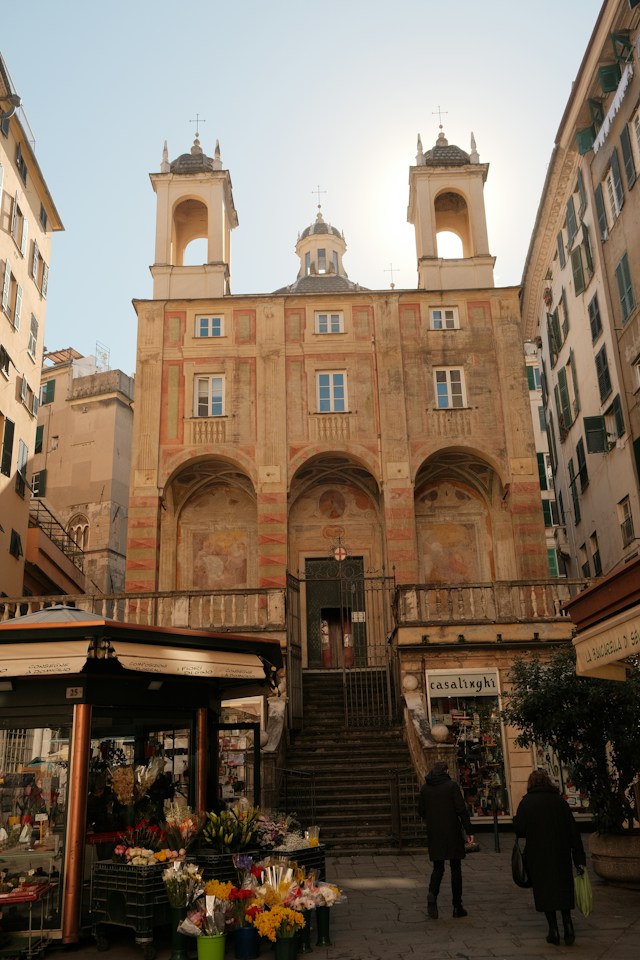
The old town is a maze of narrow alleys called caruggi. Some are so tight you can touch both walls. Your phone’s GPS will give up. That’s fine. Just walk.
You’ll pass tiny bakeries, old-school candy shops, churches tucked between apartment buildings, and little squares that open up out of nowhere. It feels lived in, because it is.
A few stops to aim for while you wander:
- The Cathedral of San Lorenzo, with its black-and-white striped front. Inside there’s a British naval shell that hit the church in 1941 and never exploded.
- Via Garibaldi, the showpiece street of the Rolli palaces. Palazzo Rosso, Palazzo Bianco, and Palazzo Doria Tursi are all museums now.
- Porto Antico, the old harbor, where you’ll find the Aquarium of Genoa. It opened in 1992 and it’s one of the largest in Europe. Kids love it.
- Spianata Castelletto, a hilltop terrace you reach by a vintage Art Nouveau elevator. The view over the slate rooftops and the port is the best one in town.
One honest note. Like any big port city, some old town alleys feel sketchy late at night. Use the same common sense you’d use in any big American city and you’ll be fine.
The Genoa Waterfront, From Lighthouse to Fishing Village
The symbol of the city is the Lanterna, a lighthouse whose current tower dates to 1543. It stands about 250 feet tall and still works. You can’t miss it on the skyline.
Then head the other direction to Boccadasse. It’s an old fishing village that the city grew around, with pastel houses stacked above a tiny pebble beach. Grab a gelato, sit on the rocks, and watch the light change. It’s simple, and it’s kind of perfect.
The walk there along Corso Italia, the seaside promenade, is where locals jog, stroll, and argue about soccer. Join them.
Okay, Let’s Talk About the Food
Look, you could come to Genoa just to eat and nobody would blame you. Ligurian cooking is lighter than what most Americans think of as Italian food. Less red sauce, more herbs, olive oil, and seafood.
Pesto is the headline. Real pesto alla genovese is basil, pine nuts, garlic, Parmigiano, Pecorino, olive oil, and salt. That’s it. It tastes brighter and greener than the jar stuff, and you’ll be a little ruined for the jar stuff afterward. Sorry.
Here’s what to order:
- Trofie al pesto: short, twisted pasta, often served with potatoes and green beans mixed in. Sounds odd. Works great.
- Focaccia: the plain kind, salty and oily, eaten warm. Locals have it for breakfast, sometimes dunked in a cappuccino.
- Focaccia di Recco: a thin, cheese-filled version from the nearby town of Recco. Completely different thing, and it’s dangerous.
- Farinata: a crispy chickpea flatbread baked in a wood oven.
- Fried seafood in a paper cone from the stands near the port. Street food at its best.
For a fun hour, stop by the Mercato Orientale off Via XX Settembre. It’s a covered market with produce, cheese, fish, and a food hall. Think of it as a farmers market that’s been at it for well over a century.
When Should You Actually Go?
Genoa has a mild Mediterranean climate, so there’s no truly bad time. But some months are easier than others. Here’s a rough breakdown.
| Season | What the weather’s like | What to expect |
|---|---|---|
| Spring (April to June) | Mild to warm, mostly 60s and 70s | Great walking weather and fewer crowds |
| Summer (July to August) | Warm and humid, highs in the low 80s | Beach season; the coast gets busy |
| Fall (September to November) | Pleasant early, then rainy | September is lovely; October and November are the wettest months |
| Winter (December to March) | Cool, usually in the 40s and 50s | Quiet streets, lower hotel rates, some gray days |
If you want my pick, it’s May or September. Warm enough for the coast, cool enough to climb all those stairs without melting.
Getting There Without Losing Your Mind
Genoa has its own airport, named for Cristoforo Colombo (airport code GOA). Nonstop flights from the US aren’t the norm, so most Americans connect through a bigger European hub or fly into Milan and take the train.
The train is easy. From Milan, you’re looking at about an hour and a half to two hours. The city has two main stations, Piazza Principe and Brignole, and both sit close to the center.
Once you’re in town, skip the rental car. Seriously. The streets are narrow, parking is a headache, and the city is built for feet. There’s a small metro line, plus buses, funiculars, and public elevators that haul you up the hills.
A few things that’ll make the trip smoother:
- Pack light. Cobblestones and stairs are rough on big rolling suitcases.
- Carry some cash in euros. Small bakeries and street food stands don’t always love cards.
- Learn a handful of Italian phrases. English is less common here than in Rome or Florence, and a little effort goes a long way.
- Plan dinner late. Many restaurants don’t open for the evening until 7:30 or so.
Day Trips That Make Staying Here a Smart Move
Here’s the thing a lot of travelers miss. Genoa makes a solid home base for the whole Italian Riviera. Hotels tend to cost less than in the famous resort towns, and the trains run up and down the coast all day.
| Destination | Rough travel time by train | Why go |
|---|---|---|
| Camogli | About 30 to 40 minutes | Colorful fishing town with a pebble beach and fewer crowds |
| Santa Margherita Ligure (for Portofino) | About 30 to 45 minutes, then a short bus or ferry ride | Classic Riviera glamour and a famous little harbor |
| Cinque Terre (Monterosso) | About 1 to 1.5 hours | Five cliffside villages and coastal hiking trails |
| Milan | About 1.5 to 2 hours | The Duomo, shopping, and big-city energy |
Travel times shift with the type of train, so check the schedule before you go. But you get the idea. You can sleep in a real city and still spend your days on the water.
Questions People Ask Before They Book
Is Genoa worth visiting?
Yes, if you like cities that feel real. It has great food, deep history, and far fewer tourists than Italy’s big names.
How many days do you need?
Two full days covers the main sights. Add a third or fourth if you want day trips along the coast.
Is it safe for tourists?
Generally, yes. Watch for pickpockets in busy areas and stick to well-lit streets in the old town at night.
Do people speak English there?
Some do, mainly at hotels and bigger restaurants. It’s less common than in Rome, so a few Italian phrases help.
What food is the city known for?
Pesto, focaccia, farinata, and fresh seafood. Pesto alla genovese started here.
Is it the same as Genova?
Yes. Genova is the Italian name. You’ll see it on train tickets and road signs.
Can you visit Cinque Terre from the city as a day trip?
You can. Direct trains reach the villages in roughly an hour to an hour and a half.
So, Should You Go?
Genoa isn’t polished. It won’t hand you a postcard moment on every corner the way Venice does. Some streets are grimy, the hills will work your calves, and you’ll get lost at least twice.
But that’s kind of the point. You get a real Italian city with palaces, sea views, and some of the best food in the country, and you get it mostly to yourself. And when you want the pretty Riviera towns, they’re a short train ride away.
So if you’re planning an Italy trip and the usual route feels a little too familiar, give Genoa a couple of days. Eat the focaccia warm. Ride the elevator up to Castelletto at sunset. You might come home telling your friends about the one city they’ve never thought to visit.
Leave a Reply